
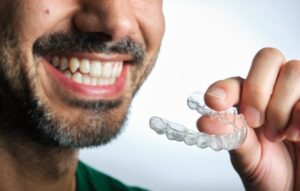
If you’re considering Invisalign to straighten your teeth, you might wonder whether existing dental work could affect your eligibility. Many people have restorations such as crowns, bridges, veneers, or fillings, and it’s natural to question whether these treatments will interfere with orthodontic care.
The good news is that in many cases, you can still get Invisalign even if you have dental restorations. However, your dentist or orthodontist will need to evaluate your specific situation before beginning treatment.
Invisalign and Dental Crowns
Dental crowns are one of the most common restorations people have when starting Invisalign. Fortunately, crowns typically do not prevent you from wearing clear aligners.
The aligners are custom-made to fit snugly over your teeth, including crowned teeth. Because the crown covers the natural tooth structure, it usually moves along with the tooth just like any other tooth during treatment.
However, your dentist will make sure the crown is stable and properly fitted before beginning Invisalign to ensure the best results.
Invisalign and Dental Fillings
Fillings generally do not interfere with Invisalign treatment either. Since fillings simply restore part of the tooth’s structure, they do not affect how the aligners fit or how the teeth move.
In fact, many Invisalign patients have multiple fillings and complete treatment successfully without any complications.
Your dentist may check the condition of older fillings before treatment begins to ensure they remain secure throughout the process.
Veneers and Invisalign
Patients with veneers can sometimes still receive Invisalign, but the situation may require additional planning. Veneers are bonded to the front surface of teeth, and while they move along with the tooth, they may affect how attachments are placed during treatment.
Attachments are small tooth-colored bumps occasionally used to help aligners apply the right amount of pressure. Because veneers have a different surface than natural enamel, your dentist will carefully determine where attachments can be placed safely.
In some cases, Invisalign may even be recommended before getting veneers to ensure the teeth are properly aligned first.
Dental Bridges and Other Considerations
Dental bridges can present more limitations because they connect multiple teeth together. Since bridges do not move like natural teeth, they may affect how the surrounding teeth can shift during orthodontic treatment.
This doesn’t automatically rule out Invisalign, but it may require adjustments to the treatment plan.
Every smile is unique, and the presence of dental restorations doesn’t automatically mean Invisalign isn’t an option. During your consultation, your dentist will evaluate your restorations, overall oral health, and orthodontic goals. With careful planning, many patients with crowns, fillings, or veneers can successfully achieve straighter teeth using Invisalign while preserving their existing dental work.
About the Author
Dr. Jason Kaopua has more than 2 full decades of experience in the dental field. He earned his doctorate at Oregon Health & Sciences University. He has completed advanced training in a wide variety of specialty topics in order to advance his clinical prowess, including sleep apnea, BOTOX, dental implant placement, Invisalign, Lumineers, soft tissue laser treatment, and more. Dr. Kaopua believes that staying up-to-date and attending extensive continuing education helps his entire team provide truly exceptional care to patients. Interested in Invisalign treatment? We’ve got you covered! Book online or call (425) 267-3333.